
5 Guitar Wall Rack Fixes That Actually Solve Crowded Studio Clutter
Key Takeaways
- Replacing an isolated wood wall mount guitar hanger with a modular rail system cuts mounting drill holes by up to 90%.
- Rotating prongs and tension straps solve asymmetric headstock slips common with Telecaster and Stratocaster designs.
- Inert silicone coatings prevent expensive nitrocellulose finish burns caused by volatile plasticizers in cheap rubber hangers.
- Multi-depth tiered hooks let you store electrics, acoustics, banjos, and ukuleles within a single compact 1-metre wall footprint.
Table of Contents
- The Crowded Studio Dilemma: Beyond the Traditional Wood Wall Mount Guitar Hanger
- Fix 1: Taming Asymmetric Headstocks on a Multi Guitar Hanger
- Fix 2: Mixing Classical, Banjo, and Ukulele Necks Without Clashes
- Fix 3: Preventing Chemical Finish Burn with Silicone Guitar Hook Sleeves
- Fix 4: Multi-Tier Depth Spacing to Overcome Wall Overcrowding
- Fix 5: Upgrading From a Single Wood Wall Mount Guitar Hanger to a Heavy-Duty Rail
- Storage Hardware Comparison: Single Hanger vs Modular Rail
- Frequently Asked Questions
- Top 5 Industry Problems This Product Solves
- Conclusion: Transform Your Rehearsal Space in 2026
Setting up an inspiring creative space in 2026 often runs straight into a brick wall—literally. Many guitarists start by securing a traditional wood wall mount guitar hanger for their primary instrument, only to watch their studio floor descend into a maze of trip hazards as banjos, baritone ukuleles, and acoustics enter the rotation. When floor space is at a premium, clutter compromises workflow, drains creative momentum, and places fragile tonewoods right in the blast zone of rolling desk chairs.
While an individual wood wall mount guitar hanger adds classic decorative appeal for a solo instrument, trying to align six or eight standalone mounts across a studio wall inevitably leaves behind a swiss-cheese pattern of misaligned drill holes. According to building integrity guides by Wikipedia, repeated anchor drilling into dry partition walls dramatically compromises structural stud capacity. Musician rooms need a streamlined, heavy-duty alternative that handles multi-instrument profiles simultaneously.
By transitioning toward an engineered guitar wall rack rail system, players can hang complex collections using high-density configurations. Below, we break down the five most prevalent instrument storage failures musicians face in 2026 and detail actionable engineering fixes that keep your stringed collection accessible, pristine, and secure.

The Crowded Studio Dilemma: Beyond the Traditional Wood Wall Mount Guitar Hanger
Home recording setups demand agile workflow. Having your instruments locked inside heavy flight cases prevents spontaneous tracking sessions, leading directly to practice stagnation as highlighted in Breaking Past Musician Fatigue: 5 Storage Tips for Subscribed Gear. Wall mounting is the natural remedy, but off-the-shelf single mounts quickly hit functional roadblocks when mixed instruments enter the room.
The Problem With Fixed-Spacing Wall Blocks
Traditional wooden blocks screw into a single position with static prongs. When you place a bulkier hollow-body electric next to a deep dreadnought acoustic, the bodies collide or swing dangerously close. Static blocks offer zero horizontal glide, forcing you to estimate clearance measurements before drilling permanent screws into masonry or drywall.
Load Fatigue Across Multiple Wall Anchor Points
Every isolated hanger requires two to four fixing screws. Mounting eight guitars translates into up to 32 drill holes, each representing a potential failure point if drywall toggles work loose over years of repetitive loading. High-performance modular rails solve this by anchoring across heavy-duty tracks using only three primary fixing points.
Aesthetics Versus Studio Scalability
While an ornamental hardwood plate looks handsome in isolation, repeating that aesthetic eight times creates visual chaos on your studio accent wall. Industrial powder-coated aluminum or steel rail channels unify the visual baseline, creating an organized, gallery-style guitar wall display that modern music producers prefer in 2026.
Ready to clear your studio floorboards and display up to 9 instruments on a single metre of wall space?
Explore the GearHooks Multi-Guitar Wall Rack →Fix 1: Taming Asymmetric Headstocks on a Multi Guitar Hanger
One of the most frequent customer complaints with standard hangers involves asymmetrical 6-in-line headstocks, such as Fender Stratocasters, Telecasters, and modern reverse-headstock metal axes. Because the left tuning peg array sits lower than the treble side, the guitar frequently tilts, slips, or rests on a delicate tuning machine.
Adjustable Hook Rotation
Rather than relying on fixed horizontal prongs, advanced rail systems feature independent rotating brackets. By offsetting the prong angle by just 5 to 10 degrees, the lower prong catches the neck shoulder at the exact height required to keep the instrument hanging dead vertical. This eliminates asymmetric headstock slide without placing lateral torque on the truss rod.
Safety Retention Straps for Offset Necks
Guitars with aggressive headstock angles or slender vintage nuts require additional containment. High-grade systems incorporate quick-release safety retaining bands that stretch across the open prong mouths. These straps ensure that accidental bumps during fast instrument swaps never dislodge an offset headstock from its cradled seat.
Ergonomic Clearance for In-Line Tuners
Standard narrow hangers often pinch the bottom tuning post against the hanger arm, knocking your high-E string flat every time you dock the instrument. Ensuring prong spacing allows full peghead clearance protects intonation, a subject covered in our guide on Tuning Tools at Home vs Stage Setup: Pros, Cons, and Storage.
Fix 2: Mixing Classical, Banjo, and Ukulele Necks Without Clashes
Modern home studios are rarely mono-instrument spaces. A producer may track a nylon-string classical guitar on track one, a tenor ukulele on track two, and an open-back banjo on the bridge. Yet standard hangers assume every instrument shares a uniform 43mm nut width.

Accommodating Wide Classical and 12-String Necks
Standard prong gaps measure roughly 45mm. This works for standard acoustics and electrics, but classical guitars and 12-string models routinely feature 48mm to 52mm nuts. On heavy-duty cold-rolled steel hooks, the outermost prongs can be carefully widened to seat wide-neck classicals without wedging the nut finish against rigid metals.
Integrating Ukulele and Mandolin Spacing
Placing an ultra-narrow soprano ukulele neck onto a standard guitar prong causes the body to drop through until stopped by delicate friction pegs. Dedicated modular instrument rails allow you to swap in specialized compact hooks or slide accessory mounts directly between full-sized guitars. This creates a functional ukulele wall rack zone on the exact same rail without purchasing disconnected wall hardware.
Managing Heavy Banjo Resonators
Banjos carry excessive rear weight distribution due to heavy cast bronze tone rings and wooden resonators. A standard wood wall mount guitar hanger can pull outward against drywall anchors under this eccentric load. Securing heavy folk instruments demands a rail system engineered with high shear strength, where load distribution spreads evenly across the entire mounting track.
Fix 3: Preventing Chemical Finish Burn with Silicone Guitar Hook Sleeves
Few disasters sting more than unhooking a prized Gibson Custom Shop or vintage Martin to discover melted, blistered lacquer right at the headstock contact points. This is known in lutherie as "chemical finish burn," and it remains a massive hazard with budget hanging hardware.
The Chemistry of Nitro Lacquer and Plasticizers
Nitrocellulose lacquer is a porous, vegetable-based organic finish. Common hanger pads manufactured from thermoplastic rubber (TPR), neoprene, or cheap vulcanized foam contain volatile chemical plasticizers. These plasticizers leach out over time, melting into the nitro finish and turning pristine clear-coat into sticky orange-peel residue. According to scientific materials data documented by NCBI, volatile organic compounds migrate readily between flexible polymers and organic lacquers under steady contact pressure.
Why Inert Medical-Grade Silicone is the Standard
Unlike oil-based foams, cured high-grade silicone is chemically inert. It contains no phthalates or leaching plasticizers, ensuring that it will not react with sensitive lacquer formulations. Installing a certified silicone guitar hook guarantees that your heirloom instruments remain safe from unsightly cosmetic degradation.
Long-Term Friction Protection
Beyond chemical safety, silicone provides resilient physical cushioning. Foam sleeves break down, crumble, and compress over two or three years of heavy use, leaving raw steel exposed beneath. Dense silicone sleeves maintain their elastic profile indefinitely, preventing metal-to-wood contact even under the weight of an 11-pound solid-body bass.
Safeguard your nitro finishes and consolidate your entire collection with lifelong engineering.
Upgrade to Heavy-Duty Modular Rail Storage →Fix 4: Multi-Tier Depth Spacing to Overcome Wall Overcrowding
The standard way people hang instruments is side-by-side, perfectly flat against the wall. While this showcases the body face, it consumes massive amounts of horizontal wall area. In a 3x3 metre tracking room, you simply cannot hang seven guitars side-by-side without blocking doorways, acoustic diffusers, or studio monitor paths.
Linear Versus Depth Storage
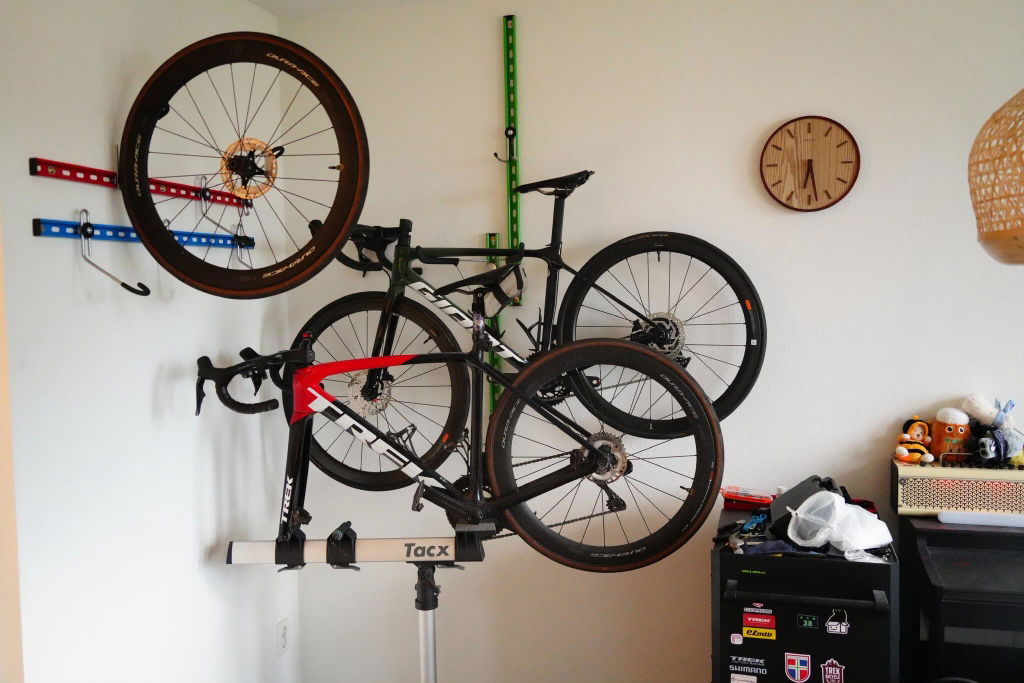
To achieve genuine space saving guitar storage, studios must look outward into 3D space rather than purely lateral planes. By extending hook prongs into 100mm, 200mm, and 300mm configurations, instruments hang layered front-to-back at gentle angles. A single 1-metre rail with 300mm hooks securely displays up to 9 instruments, compared to just 3 instruments using side-by-side single mounts.
Balancing Weight and Center of Gravity
When employing multi-depth hooks, placing your heaviest instruments closest to the wall maintains structural equilibrium. Hang solid-body mahogany electrics on the inward tier and reserve outermost tiers for featherweight acoustic parlors, ukuleles, or hollow-body electrics. This reduces cantilever rotational torque on your wall studs.
Eliminating Swivel Collisions
Layered hanging requires controlled spacing. Hooks engineered with sliding track nuts allow micro-adjustments along the rail. If you add a dreadnought acoustic with a deeper bowl, simply slide adjacent hooks 20mm sideways to prevent contact during hanging and removal.
Fix 5: Upgrading From a Single Wood Wall Mount Guitar Hanger to a Heavy-Duty Rail
When your collection outgrows two guitars, retaining isolated hardware becomes impractical. Replacing disconnected single units with an engineered modular instrument rail delivers unmatched stability and aesthetic elegance.
Drill 3 Holes Instead of 36
Installing standard hangers for nine guitars requires drilling up to 36 precision holes. One slipped masonry bit leaves an off-level hook that looks visibly crooked. With an engineered continuous track rail, you drill just 3 heavy-duty 8mm holes. Slotted rail mounting holes give you millimeters of adjustment tolerance so the track remains level even if your masonry drilling drifts slightly.
Integrating Studio Cables, Straps, and Microphones
Wall real estate beneath headstocks is often wasted. Rail systems accommodate specialized accessory hooks placed between main guitar tiers. Producers can hang stage cables, leather straps, clip-on tuners, and studio headphones directly alongside their primary instruments, eliminating console desk clutter entirely.
Designing Dynamic Wall Layouts
Rail engineering unlocks creative display layouts. Because individual prongs rotate to match any rail angle, you can mount dual rails in matching parallel lines, dramatic V-shapes, or staggered stair steps across vocal booths. Read our planning breakdown in Multi-Instrument Storage Upgrades for Travelers Worth the Money in 2026 for multi-tier layout blueprints.
Storage Hardware Comparison: Single Hanger vs Modular Rail
Understanding the technical differences between retail hanging hardware helps avoid structural wall failures and damaged instruments. Here is how modern storage approaches compare:
| Storage Metric | Single Wood Wall Mount Guitar Hanger | Floor Standing Multi-Rack | GearHooks Multi-Guitar Rail |
|---|---|---|---|
| Wall Holes (9 Guitars) | 18 to 36 drill points | 0 drill points | Only 3 drill points |
| Floor Footprint | 0 sq ft | 6 to 9 sq ft floor loss | 0 sq ft (100% floor clearance) |
| Finish Compatibility | Varies (often reactive rubber) | Usually standard foam | 100% Non-reactive silicone |
| Headstock Versatility | Fixed prongs | Body-cradle only | Rotatable hooks + widening options |
| Accessory Mounting | None | None | Dedicated strap, cable & mic hooks |

Frequently Asked Questions
Can I hang an asymmetrical Fender Stratocaster safely on this rack?
Can I hang an asymmetrical Fender Stratocaster safely on this rack?
Yes. Stratocasters and Telecasters feature asymmetrical 6-in-line headstocks that tilt on generic hangers. On GearHooks rails, hooks can be slightly rotated so the prongs cradle uneven headstocks horizontally. For extra peace of mind, included safety retaining straps prevent forward movement.
Will the hook coating damage vintage nitrocellulose lacquer?
No. GearHooks prongs are sleeved with high-grade, chemically inert silicone rather than cheap petroleum-based rubber or foam. Cured silicone does not leach chemical plasticizers, eliminating the chemical reactions that blister and burn delicate vintage nitro finishes.
How much wall space do I need for a 9-guitar rail?
The standard GearHooks GTR9 rail measures approximately 1 metre in width. By using tiered 300mm prongs, nine guitars store comfortably across this 1-metre span, saving extraordinary amounts of lateral space compared to side-by-side single hangers.
Can I store a banjo or ukulele on the same rail as my electric guitars?
Yes. The sliding clamp system lets you adjust spacing along the rail at will. For narrow soprano or concert ukuleles, dedicated accessory hooks fit between full-sized guitars, or you can widen outer prongs to fit wide-neck classicals and banjos.
What type of wall construction is required for installation?
GearHooks rails mount safely to solid brick, masonry, concrete, or directly into timber wall studs inside drywall partitions using 8mm heavy-duty fixings. Because each rail requires only 3 holes, locating studs or drilling masonry takes just minutes.
What is the benefit of a rail over a single wood wall mount guitar hanger?
A single wood wall mount guitar hanger is fine for one instrument, but scaling up requires multiple wall penetrations and locks your spacing forever. A rail requires only 3 drill holes total, supports up to 9 instruments, and lets you slide, rotate, or reconfigure hooks as your collection evolves.
Top 5 Industry Problems This Product Solves
-
Wall Deterioration from Excessive Anchoring: Replaces up to 36 individual mounting drill holes with just 3 heavy-duty structural fixings, preserving plaster and drywall integrity.
-
Severe Studio Floor Congestion: Elevates up to 9 instruments completely off the floor, eliminating floor stand trip hazards and protecting instruments from vacuum cleaners and studio desk wheels.
-
Permanent Nitrocellulose Finish Meltdown: Completely eliminates phthalate-leaching rubber padding by utilizing chemically inert silicone sleeves that protect expensive vintage clear coats.
-
Asymmetric Headstock Slips: Solves Fender-style offset peghead tilt through freely rotating hook brackets and secondary elastic security straps.
-
Rigid Multi-Instrument Incompatibility: Empowers musicians to mix electric guitars, deep acoustic bodies, wide classical nuts, banjos, and ukuleles on a single, continuously adjustable modular rail.
Stop wrestling with studio clutter and protect your instruments with a system built to last a lifetime.
Order Your Multi-Guitar Wall Rack Today →
Conclusion: Transform Your Rehearsal Space in 2026
- Wall Deterioration from Excessive Anchoring: Replaces up to 36 individual mounting drill holes with just 3 heavy-duty structural fixings, preserving plaster and drywall integrity.
- Severe Studio Floor Congestion: Elevates up to 9 instruments completely off the floor, eliminating floor stand trip hazards and protecting instruments from vacuum cleaners and studio desk wheels.
- Permanent Nitrocellulose Finish Meltdown: Completely eliminates phthalate-leaching rubber padding by utilizing chemically inert silicone sleeves that protect expensive vintage clear coats.
- Asymmetric Headstock Slips: Solves Fender-style offset peghead tilt through freely rotating hook brackets and secondary elastic security straps.
- Rigid Multi-Instrument Incompatibility: Empowers musicians to mix electric guitars, deep acoustic bodies, wide classical nuts, banjos, and ukuleles on a single, continuously adjustable modular rail.
Stop wrestling with studio clutter and protect your instruments with a system built to last a lifetime.
Order Your Multi-Guitar Wall Rack Today →Conclusion: Transform Your Rehearsal Space in 2026
Every minute spent maneuvering around floor clutter or detangling instrument cords is a minute taken away from practicing, recording, and creating. Upgrading from the limitations of an isolated wood wall mount guitar hanger to an engineered, modular rail transforms your creative zone into a clean, museum-grade production space. When instruments are safely displayed, perfectly spaced, and instantly within reach, playing music becomes second nature. Explore our collection of British-engineered rail solutions today to declutter your studio with zero compromise.

🛍️ Part of a Collection
Guitar wall mounts | Hooks & Racks | GearHooks
Discover all products in this collection
View Full Collection →